
Blogs Where Nature Meets Science & Coatings
"If All the Greedy People that Pollute can get Together & Show Strength in Unity – then Honest, Environmentalists Must Do the Same. You See – It’s as Simple As That.” George C. Keefe - ENCASEMENT Guy
Blogs Where Nature Meets Science & Coatings
"If All the Greedy People that Pollute can get Together & Show Strength in Unity – then Honest, Environmentalists Must Do the Same. You See – It’s as Simple As That.” George C. Keefe - ENCASEMENT Guy
Wednesday, January 03, 2024
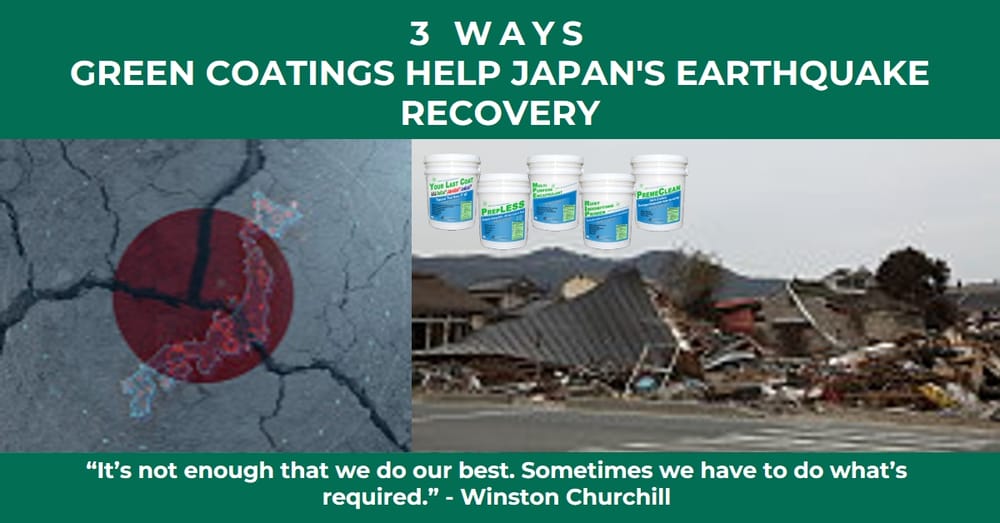
On New Year's Day, sadly central Japan was struck by a powerful 7.5 magnitude earthquake, leaving a trail of destruction, collapsed buildings, fires, and triggering tsunami alerts across the region.
Listen and Learn: Dive into the Audio Version of Our Blog
On New Year's Day, sadly central Japan was struck by a powerful 7.5 magnitude earthquake, leaving a trail of destruction, collapsed buildings, fires, and triggering tsunami alerts across the region.
The immediate aftermath of such disasters poses significant threats to human life and infrastructure, but the hidden dangers lie in the secondary exposure risks during the cleanup process.
I’ve personally been involved in large scale clean ups after disasters using my expertise in containing solid hazardous materials, including the debris clean up from the Fukushima, nuclear disaster in Japan over a decade ago.
This blog explores the environmental hazards associated with debris left behind after building collapses and how green coatings can play a crucial role in preventing secondary exposure.
Immediate and Secondary Exposure Risks:
When an earthquake of this magnitude hits, buildings crumble, and their contents become a chaotic mess of debris.
The immediate exposure to hazards during the earthquake is well-documented, but the long-term risks emerge during the cleanup phase.
The debris often contains hazardous materials such as heavy metals (antimony, chromium, arsenic, cadmium, copper, lead, and zinc) and electronic waste (from computers, monitors, batteries), as well as toxic substances like paints, PCBs, and asbestos.
The Threat of Airborne Contamination:
As the cleanup efforts begin, improperly managed debris poses a significant threat of airborne contamination, leading to what is known as secondary exposure.
When the hazardous materials are not safely wet down or contained, they become airborne, spreading toxicity in the vicinity.
This poses a severe risk to those involved in the cleanup operation, nearby residents, and even people in surrounding neighborhoods.
The Role of Green Coatings in Disaster Recovery:
Green coatings act as a vital tool in disaster recovery by providing a protective barrier against the release of hazardous materials during cleanup.
These coatings, when applied to surfaces, serve as a wetting and locking agent, effectively containing the debris and preventing the dispersion of harmful substances into the air.
Benefits of Green Coatings:
1. Containment: Green coatings help to bind hazardous materials, keeping them in place and preventing their release into the air.
2. Stabilization: By encapsulating the debris, these coatings stabilize the contaminants, reducing the risk of further environmental spread.
3. Environmentally Friendly: True to their name, green coatings are environmentally friendly, non-toxic, biodegradable and sustainable, minimizing the impact on the ecosystem.
Preventing Secondary Exposure:
To prevent secondary exposure, it is crucial to prioritize the application of green coatings during the initial stages of the cleanup process.
This ensures that the hazardous debris remains safely contained until it can be properly removed and disposed of.
Authorities and cleanup crews must be equipped with the knowledge and resources to utilize these coatings effectively.
Conclusion:
Japan's recent earthquake serves as a stark reminder of the dual threats posed by immediate and secondary exposure in the aftermath of natural disasters.
Implementing preventive measures, such as the application of green coatings, can significantly mitigate the risks associated with airborne contamination during cleanup efforts.
As we witness the resilience of communities in the face of adversity, let us also recognize the importance of sustainable practices in rebuilding a safer and healthier environment.
“It’s not enough that we do our best. Sometimes we have to do what’s required.” Winston Churchill
What are your questions?
We are always here to help and excited to answer them.
Contact us at +1 (800) 266-3982 , or send us an email at service@encasement.com and leave a comment below.
See other posts like this one:

Tuesday, November 10, 2026
The word "abatement" doesn't mean "rip it out." Understanding the real definition can save building owners tens of thousands of dollars -- and spare them years of unnecessary disruption. In my 50+ years in the field, I've watched this single misconception drive some of the most wasteful decisions in building management. It's time to set the record straight.
Tuesday, November 03, 2026
A quote, a warning, and a practical response — because when reason is under attack, doing the right thing becomes both a moral act and a market advantage.

Tuesday, October 27, 2026
The storms are not coming. They are already here. Climate science has spent decades warning us about intensifying heat, heavier rainfall, rising seas, stronger coastal hazards, and weather extremes that place aging buildings under stresses many of them were never designed to endure.

Tuesday, October 20, 2026
Less than 9% of the people applying protective coatings to buildings and structures in America are women — in a trade that requires no special strength, no tools a woman doesn't already know how to use, and no barriers that have anything to do with capability. That statistic isn't just surprising. From my experience, it represents one of the largest untapped professional opportunities in the country — and it's about to get even bigger.

Tuesday, October 13, 2026
The maintenance-treadmill coating industry has a dirty secret: your building's repeated failures aren't bad luck. They're the business model. Here's what 40+ years in the field taught me, and what Green ENCASEMENT Coatings do about it.

Tuesday, October 06, 2026
Ordinary paint can make a building look protected while heat, moisture, UV, wind, and seasonal movement keep attacking beneath the surface. Green ENCASEMENT Coatings change the protection strategy.
Tuesday, September 29, 2026
The Renewable Revolution: How Green ENCASEMENT Coatings Are Redefining Building Surfaces

Tuesday, September 22, 2026
History has already shown where buildings fail. The smarter strategy is to study those failures, strengthen the envelope before the next event, and preserve what can still be protected.
Tuesday, September 15, 2026
How Green ENCASEMENT Coatings are rewriting the rules of hail protection — before impact damage becomes a roof replacement problem.

Tuesday, September 08, 2026
Why Green ENCASEMENT Coatings can cost more at the beginning — and still cost far less over the life of your building.





Tuesday, August 04, 2026
