
Blogs Where Nature Meets Science & Coatings
"If All the Greedy People that Pollute can get Together & Show Strength in Unity – then Honest, Environmentalists Must Do the Same. You See – It’s as Simple As That.” George C. Keefe - ENCASEMENT Guy
Blogs Where Nature Meets Science & Coatings
"If All the Greedy People that Pollute can get Together & Show Strength in Unity – then Honest, Environmentalists Must Do the Same. You See – It’s as Simple As That.” George C. Keefe - ENCASEMENT Guy
Monday, September 18, 2023
In the ever-evolving landscape of sustainability, California, one of my home states has emerged as a beacon of progress, continuously pushing the boundaries of environmentally conscious practices.

In the ever-evolving landscape of sustainability, California, one of my home states has emerged as a beacon of progress, continuously pushing the boundaries of environmentally conscious practices.
The latest development in this ongoing journey is a groundbreaking update to the state's building codes, set to take effect in July 2024.
This forward-looking initiative is poised to revolutionize the construction industry by addressing a critical yet often overlooked aspect of environmental impact: embodied carbon emissions.
Embodied carbon refers to the emissions generated throughout a building's entire lifecycle, including manufacturing, transportation, installation, maintenance, disassembly, and waste disposal of construction materials.
Unfortunately, this issue has not always received the attention it deserves in building policies. Several factors have contributed to this oversight.
The intricate nature of material supply chains has made it challenging to track and manage embodied carbon.
Overcoming technological barriers to decarbonization has proven to be a complex and multifaceted task.
The absence of standardized data has further complicated efforts to address embodied carbon.
California has a storied history of leadership in sustainability, that I have witnessed first-hand, dating back to the 1970s when it introduced an energy code.
Also a leader in restricting amounts of VOC’s coming from paints which was one of the factors in directly influencing my decision to provide only Green Coatings to the market.
In the past decade, the state has been at the forefront of eco-friendly practices with the introduction of the mandatory statewide green building code known as CALGreen.
This legacy of pioneering sustainability measures continues to evolve.
Just last month, California achieved a historic milestone by becoming the first state in the nation to mandate the reduction of embodied carbon emissions.
The unanimous vote in favor of two building code changes signifies California's unwavering commitment to environmental stewardship.
The two building code changes are designed to target embodied carbon emissions in commercial buildings exceeding 100,000 square feet and schools spanning over 50,000 square feet.
These changes are set to come into effect on July 1, 2024, heralding a new era of sustainable construction practices.
To meet the new standards, projects have the flexibility to choose from three compliance paths.
The first path encourages the reuse of at least 45% of an existing structure, minimizing the need for new construction materials and reducing embodied carbon.
The second option requires the use of materials that fall within specified emission limits, promoting the selection of environmentally friendly materials.
And the third choice offers a performance-based compliance approach, allowing the use of a whole building life cycle assessment analysis to assess and minimize environmental impact throughout a building's lifecycle.
The adoption of these groundbreaking codes was made possible through a coalition led by the American Institute of Architects (AIA) California, with the support of organizations like the U.S. Green Building Council (USGBC).
Their collective efforts highlight the importance of collaboration in advancing sustainability.
The significance of California's code changes extends far beyond state lines.
With its massive economy and influential position, these changes are expected to catalyze a nationwide shift towards sustainable construction practices.
Moreover, they are poised to spark innovation in building materials and methodologies across the United States.

California's commitment to reducing embodied carbon emissions marks a pivotal moment in the pursuit of a greener and more sustainable future.
As these changes take effect in 2024, they set the stage for a transformative shift in the construction industry, setting a remarkable example for the entire nation.
Myself and GEI (Global Encasement, Inc.), stand ready to support this green revolution with our eco-friendly Green Coatings Encasement, contributing to a cleaner and more sustainable world.
Wanted to learn more about this. Contact me at ask@encasementguy.com
Share your thoughts,support our mission and help the community to know more about safeguarding our planet's brighter Future.
“If All the Greedy People that Pollute can get Together & Show Strength in Unity – then Honest, Environmentalists Must Do the Same. You See – It’s as Simple As That.”
George C. Keefe/ENCASEMENT Guy
See other posts like this one:
Tuesday, November 17, 2026
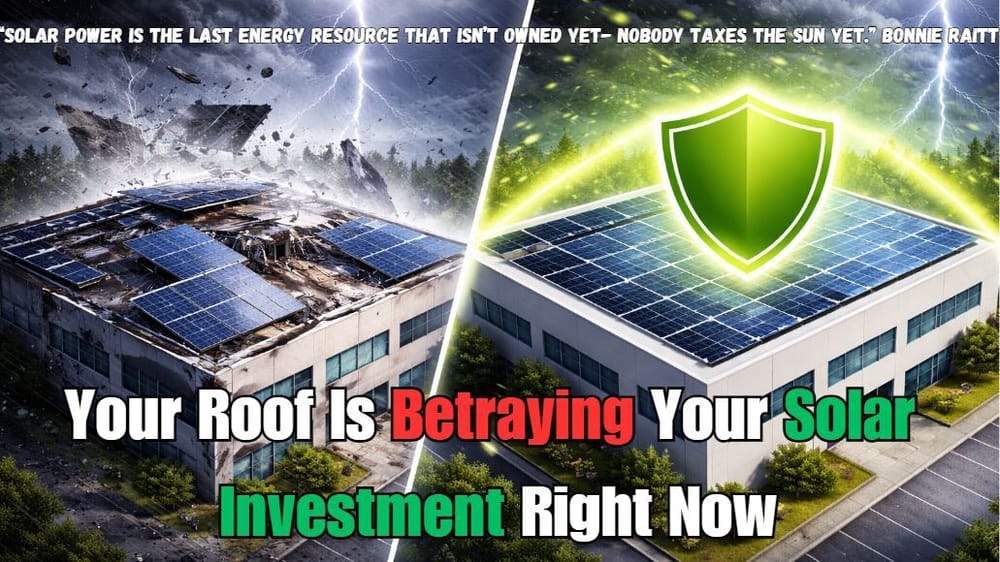
Solar can reduce dependence on volatile energy markets and turn rooftops into productive assets. But a rooftop solar system and the roof beneath it must be planned as one long-term system — because a clean-energy investment can become a costly maintenance problem if the roof, attachment points, and water-control details are not ready for decades of service.

Tuesday, November 10, 2026
The word "abatement" doesn't mean "rip it out." Understanding the real definition can save building owners tens of thousands of dollars -- and spare them years of unnecessary disruption. In my 50+ years in the field, I've watched this single misconception drive some of the most wasteful decisions in building management. It's time to set the record straight.
Tuesday, November 03, 2026
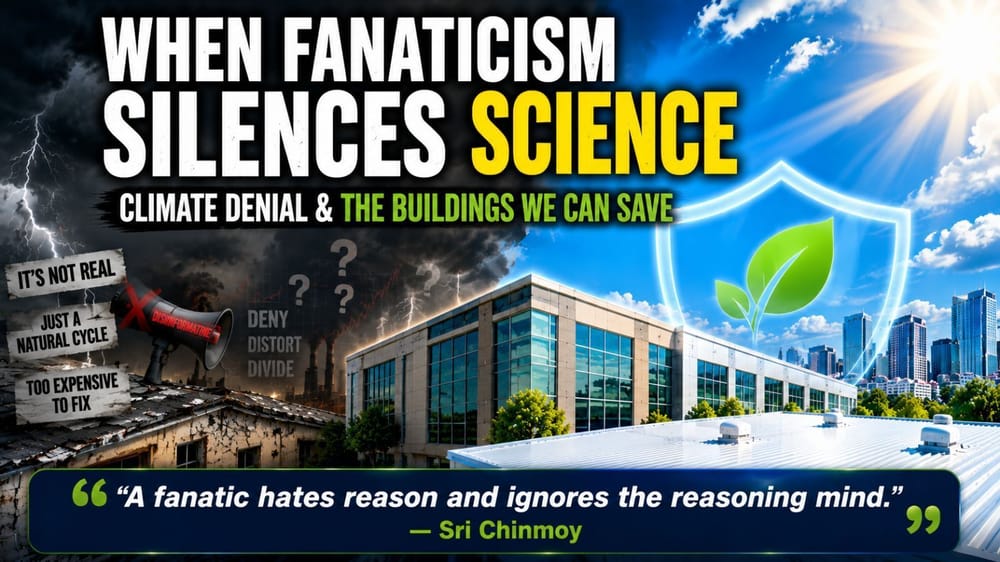
A quote, a warning, and a practical response — because when reason is under attack, doing the right thing becomes both a moral act and a market advantage.

Tuesday, October 27, 2026
The storms are not coming. They are already here. Climate science has spent decades warning us about intensifying heat, heavier rainfall, rising seas, stronger coastal hazards, and weather extremes that place aging buildings under stresses many of them were never designed to endure.

Tuesday, October 20, 2026
Less than 9% of the people applying protective coatings to buildings and structures in America are women — in a trade that requires no special strength, no tools a woman doesn't already know how to use, and no barriers that have anything to do with capability. That statistic isn't just surprising. From my experience, it represents one of the largest untapped professional opportunities in the country — and it's about to get even bigger.

Tuesday, October 13, 2026
The maintenance-treadmill coating industry has a dirty secret: your building's repeated failures aren't bad luck. They're the business model. Here's what 40+ years in the field taught me, and what Green ENCASEMENT Coatings do about it.

Tuesday, October 06, 2026
Ordinary paint can make a building look protected while heat, moisture, UV, wind, and seasonal movement keep attacking beneath the surface. Green ENCASEMENT Coatings change the protection strategy.
Tuesday, September 29, 2026
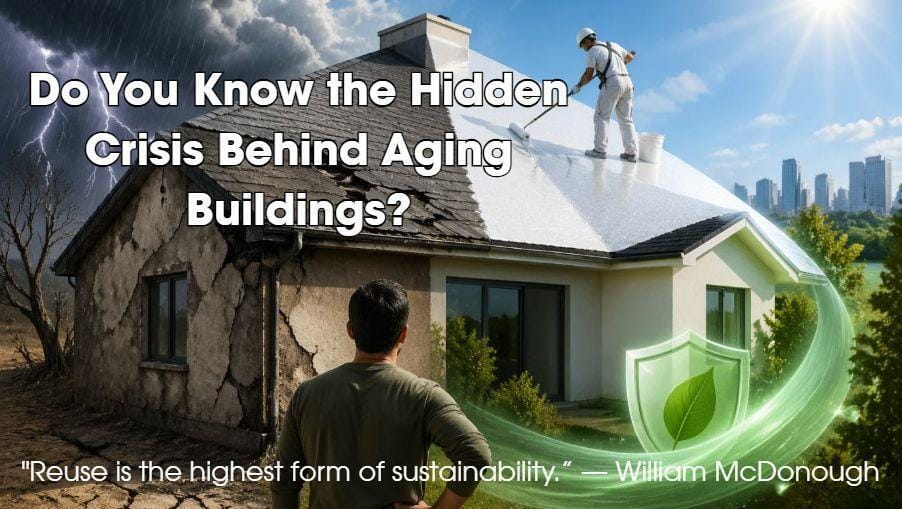
The Renewable Revolution: How Green ENCASEMENT Coatings Are Redefining Building Surfaces

Tuesday, September 22, 2026
History has already shown where buildings fail. The smarter strategy is to study those failures, strengthen the envelope before the next event, and preserve what can still be protected.
Tuesday, September 15, 2026
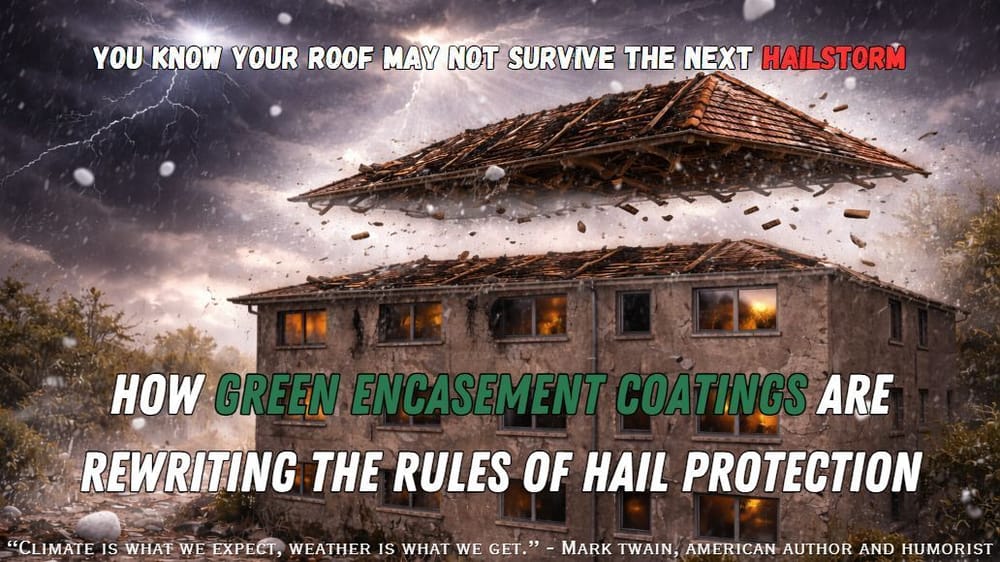
How Green ENCASEMENT Coatings are rewriting the rules of hail protection — before impact damage becomes a roof replacement problem.

Tuesday, September 08, 2026
Why Green ENCASEMENT Coatings can cost more at the beginning — and still cost far less over the life of your building.





Tuesday, August 04, 2026