Blogs Where Nature Meets Science & Coatings
"If All the Greedy People that Pollute can get Together & Show Strength in Unity – then Honest, Environmentalists Must Do the Same. You See – It’s as Simple As That.” George C. Keefe - ENCASEMENT Guy
Blogs Where Nature Meets Science & Coatings
"If All the Greedy People that Pollute can get Together & Show Strength in Unity – then Honest, Environmentalists Must Do the Same. You See – It’s as Simple As That.” George C. Keefe - ENCASEMENT Guy
Tuesday, April 07, 2026

By: George Keefe
"If all the greedy polluters can band together to protect their interests, then honest environmentalists must do the same. It's as simple as that.
Listen and Learn: Dive into the Audio Version of Our Blog
Stop paying twice for what should last once.
There's a question most property owners never think to ask when they reach for the budget can of paint: How much will it actually cost me in the end?
Not the sticker price — but the real cost.
In this episode, I reveal the true cost measured in failed coatings, water damage, storm losses, emergency repairs, and the quiet, relentless erosion of the structure you've invested everything to build and protect.
Conventional paint is, by design, a cosmetic product.
It is engineered to look good on the shelf, apply smoothly on day one, and degrade predictably within 3 to 5 years — sending you back to the store.
It is not made to protect.
It sits on your surface rather than bonding with it.
It cracks instead of flexing.
It peels when the storm comes.
And in an era of increasingly violent weather events driven by climate change, that engineered fragility carries a price tag far beyond what's printed on the label.
The Real Math Behind 'Saving Money' on Paint
It's an economical truth that it's seldom possible to get the most by spending the least.
When you choose cheap protective coatings, you're not making a one-time decision — you're signing up for a cycle.
Repaint in year three.
Repair moisture intrusion in year four.
Replace rotted substrate in year six.
Face the insurance gap when a Category 3 storm finds the seam your bargain coating left exposed.
As one of history's most enduring business principles puts it: it's unwise to pay too much, but it's worse to pay too little.
When you pay too much, you lose a little money — that is all.
When you pay too little, you sometimes lose everything, because the thing you bought was incapable of doing the thing it was bought to do.
The question was never how much you pay.
It's how often you have to repay it — and what you lose between payments.
What Climate Change Is Doing to Your Building Right Now
Storms are not what they used to be.
Hail is larger, wind is faster, rain is heavier, and freeze-thaw cycles are more erratic.
The built environment is under sustained, escalating attack.
Buildings designed for the weather patterns of thirty years ago are being asked to survive conditions that test even the most robust protective systems — let alone a thin layer of cosmetic paint applied over a porous surface.
Every seam in a conventional coating is a door for wind.
Every hairline crack is an invitation for moisture.
Every fastener hole is a future leak.
And with each storm season more punishing than the last, the risk you run by under-protecting your property grows larger, not smaller.
This is not fear — it's physics.
Green Encasement Coatings: Protection That Actually Protects
Green Encasement Coatings represent a fundamental rethinking of what building protection should be.
Rather than sitting on a surface the way paint does, these advanced coatings encase it — penetrating at the molecular level, cross-link bonding with the substrate, and curing into a seamless, monolithic membrane that becomes structurally integrated with whatever it protects.
The result is 100% waterproof, breathable, impact-resistant, UV-stable protection that flexes with thermal expansion instead of cracking, bridges gaps instead of leaving them vulnerable, and carries a guaranteed renewable service cycle of 20 years or more.
There are no seams for wind to exploit, no fasteners to fail, no pierce points to leak — just an unbroken shield across your entire building envelope.
And because they're formulated with zero to minimal VOCs, water-based chemistry, and biodegradable components, Green Encasement Coatings don't just protect your building — they actively support the environment around it.
Light-colored formulations reflect 50–80°F of surface heat back to the atmosphere, reducing cooling costs by up to 40%, combating urban heat islands, and contributing to the kind of albedo enhancement that climate scientists advocate for at scale.
To Sum IT Up:
Green Encasement Coatings are the investment that stops the cycle.
They are easily applied with standard painting tools — brushes, rollers, airless sprayers.
No specialized crews, no exotic equipment, no steep learning curve.
Local contractors can apply them.
Local communities can access them.
The barrier to protection this powerful is lower than you might expect.
What you receive in return is not a paint job.
It is a structural investment — one that stops the cycle of repayment, reduces your energy costs, encases hazardous materials like lead paint or asbestos safely in place, and defends your property against the storms that are already on their way.
The common law of business balance prohibits paying a little and getting a lot — it can't be done.
But it works beautifully in reverse: pay the right amount, once, for something built to last, and the returns compound quietly every year the coating holds, every storm it turns away, every repair bill that never arrives.
The true cost of protection is never the price of the product.
It is the price of being without it.
"Sustainability and profitability go hand in hand. That’s how you build a resilient company, whether you’re an incumbent or starting from scratch." –Henrik Henriksson
See other posts like this one:
Tuesday, November 17, 2026
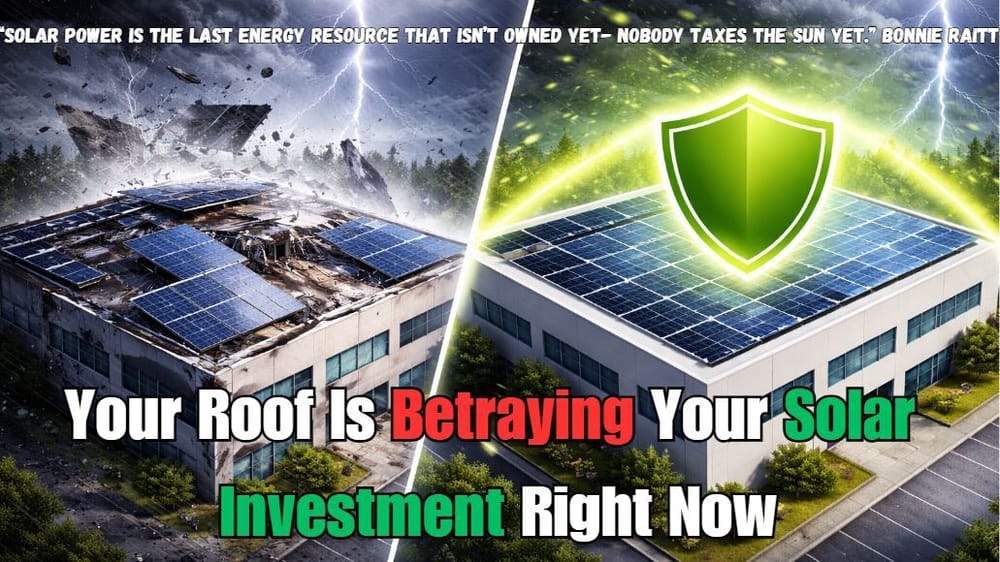
Solar can reduce dependence on volatile energy markets and turn rooftops into productive assets. But a rooftop solar system and the roof beneath it must be planned as one long-term system — because a clean-energy investment can become a costly maintenance problem if the roof, attachment points, and water-control details are not ready for decades of service.

Tuesday, November 10, 2026
The word "abatement" doesn't mean "rip it out." Understanding the real definition can save building owners tens of thousands of dollars -- and spare them years of unnecessary disruption. In my 50+ years in the field, I've watched this single misconception drive some of the most wasteful decisions in building management. It's time to set the record straight.
Tuesday, November 03, 2026
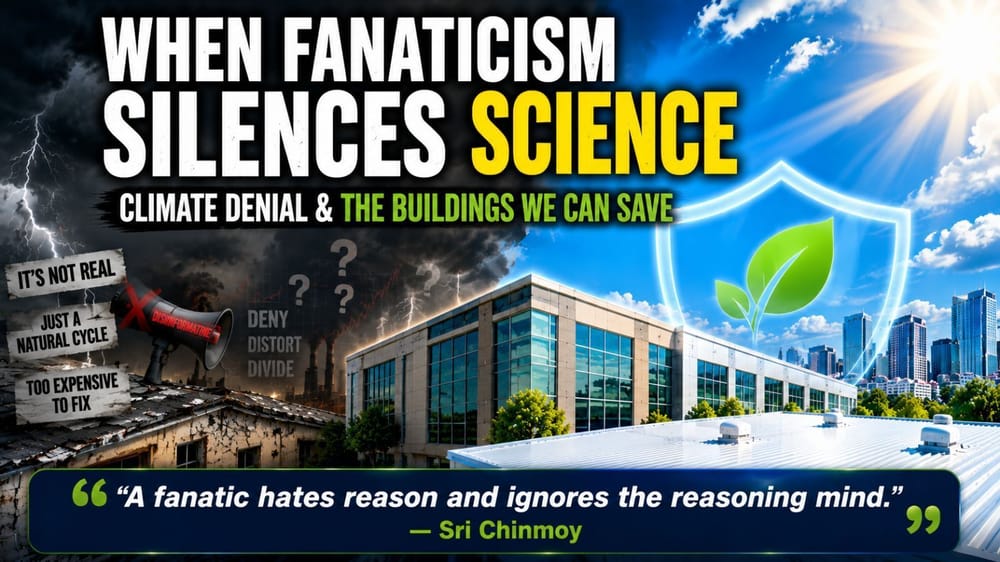
A quote, a warning, and a practical response — because when reason is under attack, doing the right thing becomes both a moral act and a market advantage.

Tuesday, October 27, 2026
The storms are not coming. They are already here. Climate science has spent decades warning us about intensifying heat, heavier rainfall, rising seas, stronger coastal hazards, and weather extremes that place aging buildings under stresses many of them were never designed to endure.

Tuesday, October 20, 2026
Less than 9% of the people applying protective coatings to buildings and structures in America are women — in a trade that requires no special strength, no tools a woman doesn't already know how to use, and no barriers that have anything to do with capability. That statistic isn't just surprising. From my experience, it represents one of the largest untapped professional opportunities in the country — and it's about to get even bigger.

Tuesday, October 13, 2026
The maintenance-treadmill coating industry has a dirty secret: your building's repeated failures aren't bad luck. They're the business model. Here's what 40+ years in the field taught me, and what Green ENCASEMENT Coatings do about it.

Tuesday, October 06, 2026
Ordinary paint can make a building look protected while heat, moisture, UV, wind, and seasonal movement keep attacking beneath the surface. Green ENCASEMENT Coatings change the protection strategy.
Tuesday, September 29, 2026
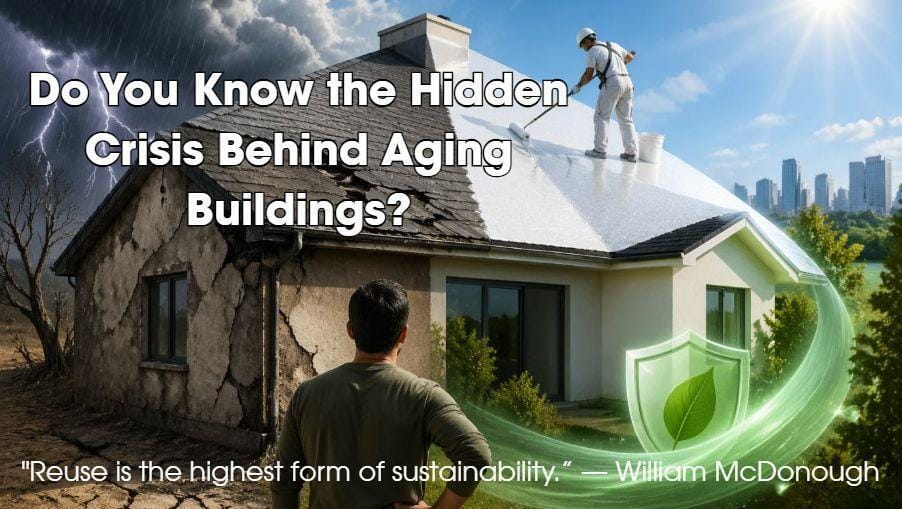
The Renewable Revolution: How Green ENCASEMENT Coatings Are Redefining Building Surfaces

Tuesday, September 22, 2026
History has already shown where buildings fail. The smarter strategy is to study those failures, strengthen the envelope before the next event, and preserve what can still be protected.
Tuesday, September 15, 2026
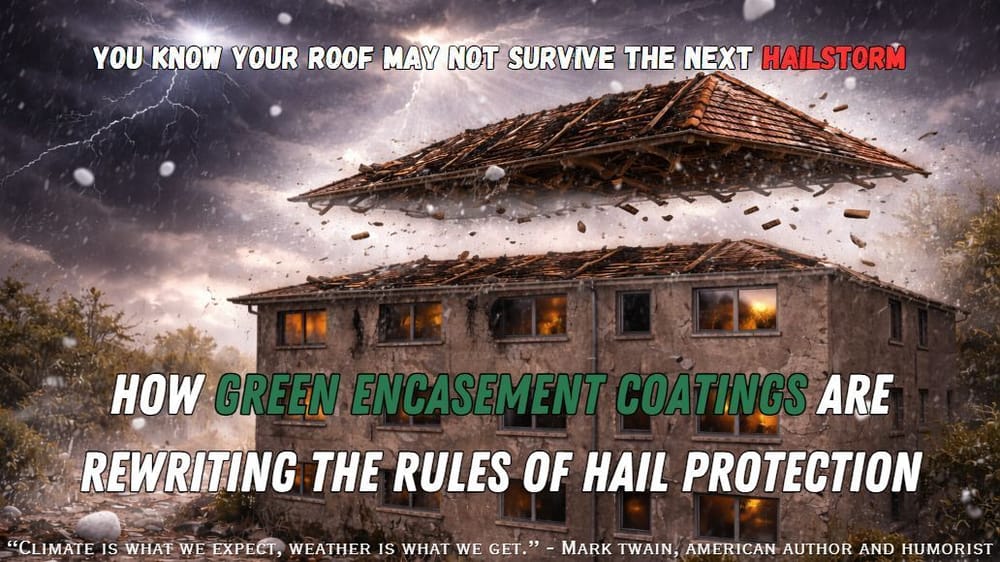
How Green ENCASEMENT Coatings are rewriting the rules of hail protection — before impact damage becomes a roof replacement problem.

Tuesday, September 08, 2026
Why Green ENCASEMENT Coatings can cost more at the beginning — and still cost far less over the life of your building.




Tuesday, August 04, 2026