Blogs Where Nature Meets Science & Coatings
"If All the Greedy People that Pollute can get Together & Show Strength in Unity – then Honest, Environmentalists Must Do the Same. You See – It’s as Simple As That.” George C. Keefe - ENCASEMENT Guy
Blogs Where Nature Meets Science & Coatings
"If All the Greedy People that Pollute can get Together & Show Strength in Unity – then Honest, Environmentalists Must Do the Same. You See – It’s as Simple As That.” George C. Keefe - ENCASEMENT Guy
Saturday, February 21, 2026

By: George Keefe
"If all the greedy polluters can band together to protect their interests, then honest environmentalists must do the same. It's as simple as that.
Listen and Learn: Dive into the Audio Version of Our Blog
What if the buildings and homes you're building today could poison your grandchildren's water?
It's a sobering thought, but one that reveals an extraordinary opportunity hiding in plain sight.
Right now, building waste represents 25-40% of everything we throw away in America—hundreds of millions of tons creating a silent crisis that doesn't have to exist.
But here's the beautiful truth: we're on the cusp of a building revolution that could transform this wasteland into a legacy of abundance.
What We Stand to Lose (And Why It Matters)
Every demolished building is more than rubble—it's our children's inheritance slipping away.
When we landfill construction materials, we're not just burying concrete and wood.
We're burying the clean water our kids will need to drink, the soil their food will grow in, and the air they'll breathe for the next century.
Asphalt roofing shingles tell the story perfectly.
From the moment they're installed on your home, they begin releasing toxic compounds into nearby streams—11 million tons annually just waiting to leach carcinogens into watersheds where families swim and fish.
Materials like lead paint and asbestos lurk in older buildings, threatening to contaminate communities for generations.
Even "harmless" concrete and treated wood can take hundreds of years to break down, turning prime land into sacrifice zones.
The real heartbreak?
We're throwing away the embodied energy it took to create these materials in the first place—energy that now accounts for nearly 20% of global greenhouse gas emissions when we factor in replacement cycles.
The Opportunity We're Claiming Back
But this story doesn't end in loss.
It begins with possibility.
Across the country, forward-thinking builders and homeowners are choosing materials designed to last 200 years, not 20.
They're renovating rather than demolishing, restoring instead of removing and replacing, recovering materials through careful deconstruction, and demanding non-toxic alternatives that won't poison the next generation's groundwater.
The shift is already happening.
Building codes are evolving to favor preservation.
Manufacturer take-back programs are emerging.
Recycling and reuse requirements are becoming standard practice.
And consumers like you are asking the right questions: "Will this material harm my family and future generations?
Can it be reclaimed?
What's its real lifetime cost?"
Your Role in This Transformation
Every choice you make about your building project creates ripples across time.
When you select durable, non-toxic materials, you're not just protecting your investment—you're safeguarding drinking water for communities a century from now.
When you renovate instead of demolish, you're preserving embodied energy and preventing toxic dust from entering your neighbors' lungs.
This isn't about sacrifice.
It's about wisdom.
The same budget that builds a 30-year structure can create a 200-year legacy.
The same effort that generates waste can recover resources.
The same project that poisons can heal.
Building a Future Worth Inheriting
We stand at a threshold moment.
Behind us, decades of disposable construction that treated our environment as an infinite dumping ground.
Ahead, a future where buildings nurture rather than poison, where materials circulate rather than accumulate, where each generation inherits abundance instead of contamination.
The buildings we construct today will either burden or bless our descendants.
That's not a guilt trip—it's an invitation to be part of something magnificent.
Every sustainable material choice, every decision to renovate rather than demolish, every demand for non-toxic alternatives moves us closer to a world where clean water flows freely, where children play on uncontaminated soil, and where the air remains breathable for centuries to come.
Your next building project isn't just about your immediate needs.
It's about choosing between loss and legacy.
And the most empowering truth of all?
The choice is yours to make, right now, today.
“Sustainability begins with respect.” - Yvon Chouinard
See other posts like this one:

Tuesday, November 17, 2026
Solar can reduce dependence on volatile energy markets and turn rooftops into productive assets. But a rooftop solar system and the roof beneath it must be planned as one long-term system — because a clean-energy investment can become a costly maintenance problem if the roof, attachment points, and water-control details are not ready for decades of service.

Tuesday, November 10, 2026
The word "abatement" doesn't mean "rip it out." Understanding the real definition can save building owners tens of thousands of dollars -- and spare them years of unnecessary disruption. In my 50+ years in the field, I've watched this single misconception drive some of the most wasteful decisions in building management. It's time to set the record straight.
Tuesday, November 03, 2026
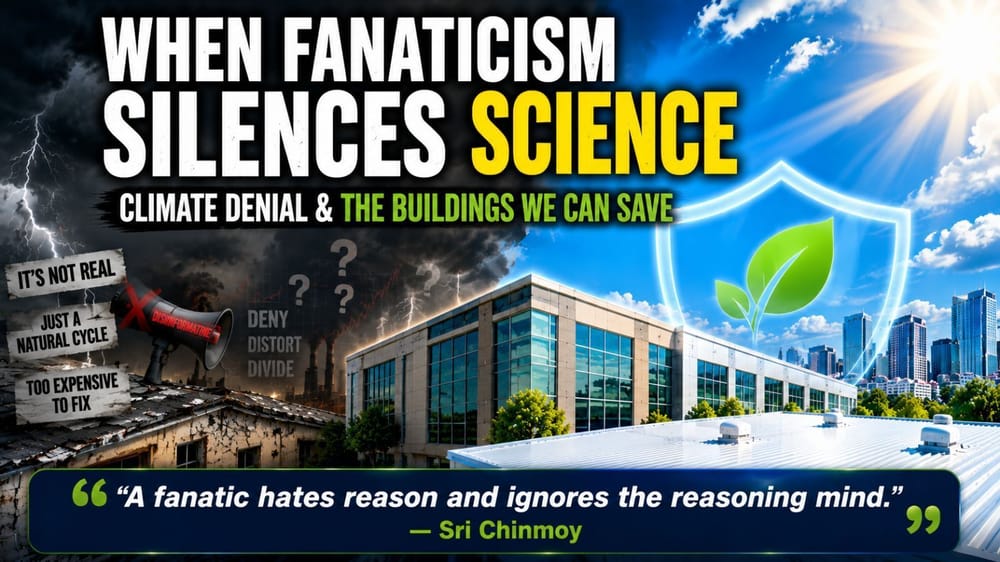
A quote, a warning, and a practical response — because when reason is under attack, doing the right thing becomes both a moral act and a market advantage.

Tuesday, October 27, 2026
The storms are not coming. They are already here. Climate science has spent decades warning us about intensifying heat, heavier rainfall, rising seas, stronger coastal hazards, and weather extremes that place aging buildings under stresses many of them were never designed to endure.

Tuesday, October 20, 2026
Less than 9% of the people applying protective coatings to buildings and structures in America are women — in a trade that requires no special strength, no tools a woman doesn't already know how to use, and no barriers that have anything to do with capability. That statistic isn't just surprising. From my experience, it represents one of the largest untapped professional opportunities in the country — and it's about to get even bigger.

Tuesday, October 13, 2026
The maintenance-treadmill coating industry has a dirty secret: your building's repeated failures aren't bad luck. They're the business model. Here's what 40+ years in the field taught me, and what Green ENCASEMENT Coatings do about it.

Tuesday, October 06, 2026
Ordinary paint can make a building look protected while heat, moisture, UV, wind, and seasonal movement keep attacking beneath the surface. Green ENCASEMENT Coatings change the protection strategy.
Tuesday, September 29, 2026
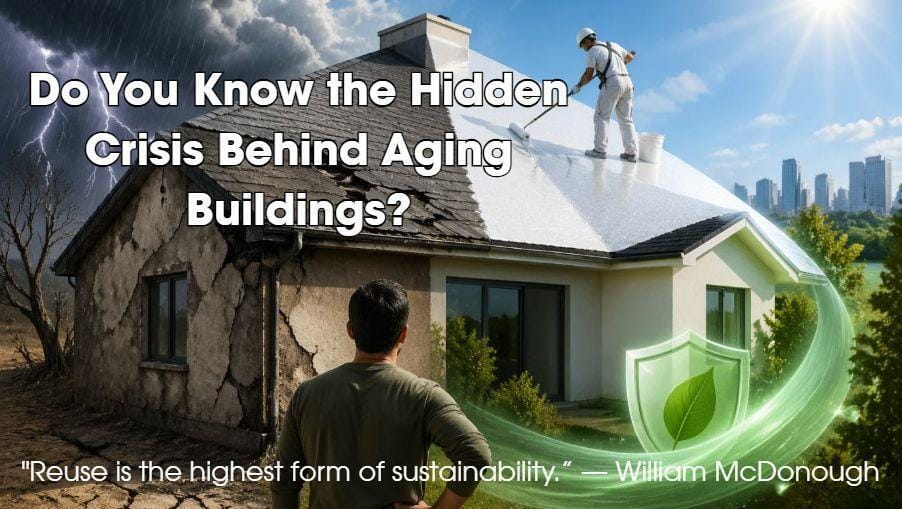
The Renewable Revolution: How Green ENCASEMENT Coatings Are Redefining Building Surfaces

Tuesday, September 22, 2026
History has already shown where buildings fail. The smarter strategy is to study those failures, strengthen the envelope before the next event, and preserve what can still be protected.
Tuesday, September 15, 2026
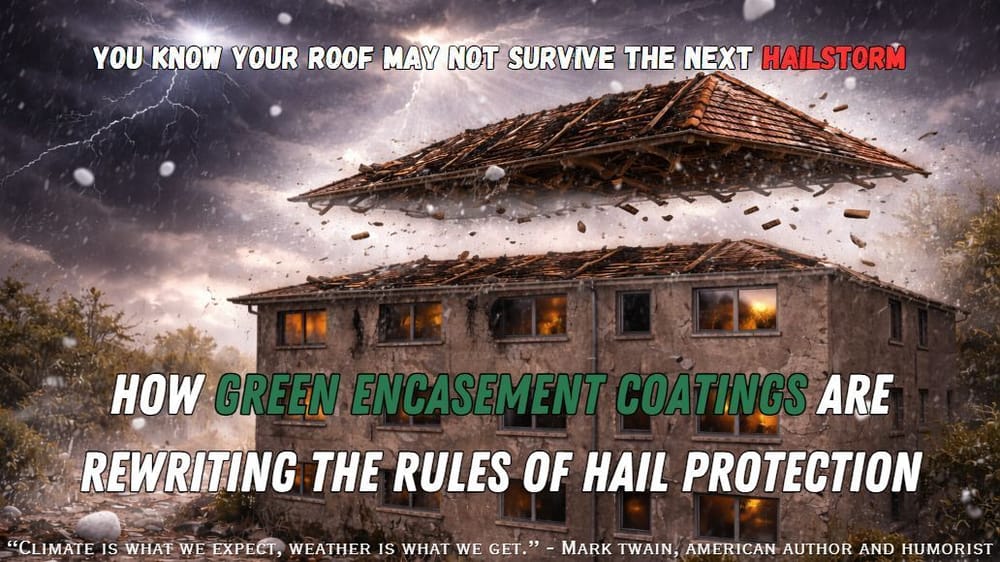
How Green ENCASEMENT Coatings are rewriting the rules of hail protection — before impact damage becomes a roof replacement problem.

Tuesday, September 08, 2026
Why Green ENCASEMENT Coatings can cost more at the beginning — and still cost far less over the life of your building.





Tuesday, August 04, 2026