
Blogs Where Nature Meets Science & Coatings
"If All the Greedy People that Pollute can get Together & Show Strength in Unity – then Honest, Environmentalists Must Do the Same. You See – It’s as Simple As That.” George C. Keefe - ENCASEMENT Guy
Blogs Where Nature Meets Science & Coatings
"If All the Greedy People that Pollute can get Together & Show Strength in Unity – then Honest, Environmentalists Must Do the Same. You See – It’s as Simple As That.” George C. Keefe - ENCASEMENT Guy
Tuesday, November 24, 2026
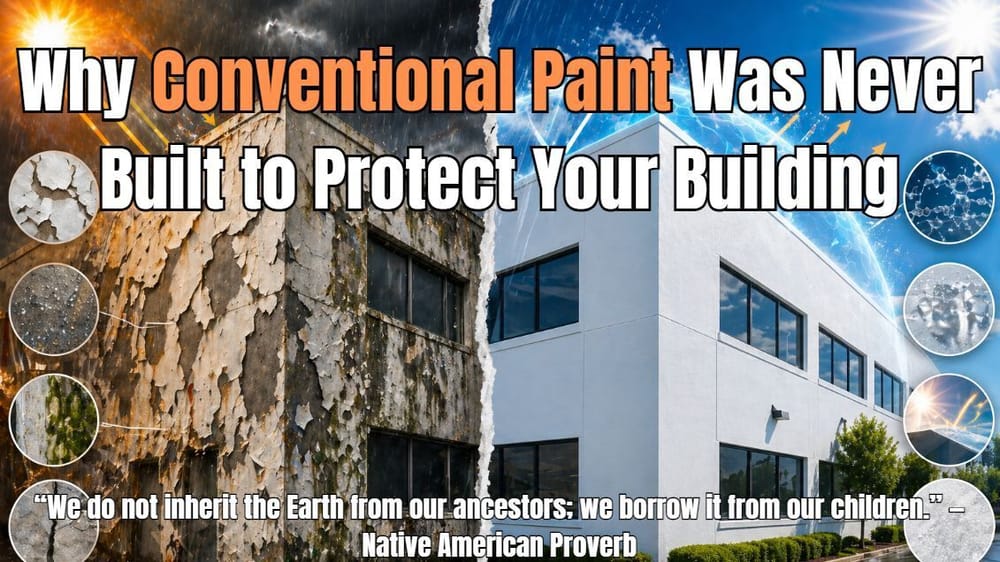
Face Mask vs. Body Armor The paint industry has spent decades selling you cosmetics while calling it protection. Here’s the truth they don’t want you to know — and what real building defense actually looks like.
By: George C. Keefe — Founder & CEO, Global Encasement, Inc. | The ENCASEMENT Guy
Technical Reference Article | Open Access | CC BY 4.0
"If all the greedy polluters can band together to protect their interests, then honest environmentalists must do the same. It's as simple as that.
Listen and Learn: Dive into the Audio Version of Our Blog
The Problem: Buildings Were Built to Last. Their Coatings Weren’t.
Walk into any hardware store, any paint distributor, any big-box home improvement warehouse.
The shelves are lined with products promising “weather-resistant,” “long-lasting,” “protective” performance.
The marketing is confident.
The colors are reassuring.
The price points range from budget to premium, all suggesting varying degrees of serious protection.
None of it is true.
Conventional paint — no matter the brand, no matter the price point, no matter how many coats you apply — was never engineered to defend a building.
It was engineered to cover one.
Those are not the same thing.
And the gap between those two definitions is where decades of building damage, unnecessary replacement costs, and avoidable environmental waste quietly accumulates.
The conventional paint industry has built a trillion-dollar business model on a fundamental deception: that a cosmetic film is the same as a protective system.
It is not.
It has never been.
And the industry knows it.
Industry Reality: Buildings lose an estimated $171 billion per year to building envelope failures — the direct result of coatings systems that cover surfaces cosmetically rather than defending them structurally
Meanwhile, indoor VOC concentrations from conventional paint run 2–5x higher than outdoor air — and up to 10x in poorly ventilated spaces. (Source: U.S. EPA, epa.gov/indoor-air-quality)
The Escalation: What Happens When Cosmetic Cover-Up Fails
Here is what conventional paint is, at the technical level: a pigmented liquid that dries into a thin decorative film on the surface of whatever substrate it is applied to.
That film does not bond at the molecular level.
It does not penetrate and cross-link with the substrate.
It sits on top.
And because it sits on top, it is perpetually at war with the forces working to remove it.
Ultraviolet radiation degrades the binder.
Temperature cycling — expansion and contraction as surfaces heat and cool — cracks and compromises adhesion.
Moisture finds every micro-fissure and works its way beneath the film, causing blistering, peeling, and substrate damage.
Chemical exposure — pollution, acid rain, industrial fallout — attacks the film from the outside while biological growth attacks from within.
This is not a failure of any particular product.
This is the category.
It is what conventional paint does because of what it fundamentally is: a cosmetic coating with a built-in expiration date.
Industry Fact: Most conventional paint systems require full reapplication every 3–7 years — a cycle that generates billions in repeat revenue for manufacturers while draining building budgets indefinitely.
The U.S. EPA reports 548 million tons of construction and demolition debris generated annually.
A significant and preventable portion is directly attributable to the cosmetic cover-up model. (Source: U.S. EPA C&D Debris, epa.gov/smm/construction-and-demolition-debris)
The paint industry does not advertise this, but their own technical data sheets confirm it.
Service life projections.
Recoat intervals.
Maintenance schedules.
The language of planned obsolescence is buried in the fine print of every major paint product on the market.
They use words like “weather-resistant” knowing that resistance is not the same as protection, and “long-lasting” knowing that five years is long in their world — even if it means nothing in yours.
Meanwhile, your building keeps aging.
Your substrate keeps degrading.
Your hazardous materials — the asbestos fireproofing, the lead-based paint, the PCB-laden caulking — keep one failed coat of paint away from becoming an active environmental liability.
And you keep buying another can.
That is not a maintenance strategy.
That is a maintenance treadmill.
Every failed coat of paint that must be stripped and replaced becomes waste.
Every substrate degraded past the point of restoration becomes a demolition project.
Every building component torn out and landfilled because conventional coatings could not keep it viable is a resource consumed, a toxin potentially released, and a carbon cost added to the global ledger.
“Weather-resistant” is not the same as weather-proof. “Long-lasting” means nothing when the standard is three years. The language of conventional paint is the language of managed disappointment — and it is costing building owners billions every cycle.
The Solution — Green ENCASEMENT Coatings
Green ENCASEMENT Coatings are not paint.
They are not an improvement on paint.
They are a fundamentally different category of product, engineered from first principles to do what conventional coatings have never been capable of: defend a building.
This three-dimensional methodology is what separates real protection from the illusion of it.
Dimension 1 — Green
Zero-VOC. Water-based. Non-toxic. Biodegradable. Ozone-safe. Solar reflective. Class A fire rated.
These are not marketing claims — they are independently verified performance standards, compliant with EPA, CARB Regulation 1113, ASTM, LEED v4, Green Seal GS-11, and OSHA HazCom 2012.
A product that is genuinely good for the building — and genuinely good for the people inside it.
Dimension 2 — ENCASEMENT
Cross-link molecular bonding with the substrate. A seamless, continuous monolithic membrane — no seams, no joints, no edges where moisture can infiltrate.
A multi-threat barrier engineered to resist UV degradation, moisture intrusion, chemical exposure, biological growth, and physical impact simultaneously, not individually, and not temporarily.
Long-lasting, guaranteed 20-year renewable service life cycles.
This is not a film that sits on top of a surface.
It is a defensive system integrated into it.
Dimension 3 — Coatings
Applied by standard brush, roller, or spray. Water cleanup. No specialized equipment. No exotic processes. No imported crews or facility shutdowns. Local labor, standard tools, breathable and self-leveling formula — so the system performs without trapping moisture or requiring perfect application conditions.
The barrier that changes everything about how your building survives, installed exactly the way conventional paint is applied — without the disruption, the waste, or the cost of removal and replacement.
Environmental Impact: Solar reflective Green ENCASEMENT Coatings reduce rooftop surface temperatures by 50–80°F and cut cooling energy consumption by 15–40%, while eliminating the landfill waste stream from tear-off and replacement.
Globally, cool roofs are estimated to offset 24 gigatons of CO₂. (Source: Lawrence Berkeley National Laboratory, lbl.gov | DOE Energy Star Program, energystar.gov)
Green ENCASEMENT Coatings doesn’t paint a surface. It encases it. That’s not semantics. That’s the entire difference between a face mask and body armor.
The Results: What Real Protection Delivers
Building owners who make the shift from the conventional paint model to Green ENCASEMENT Coatings consistently report the same discovery: the economics are not even close.
Here is what real protection looks like in practice:
•Up to 75% savings versus removal and replacement. Conventional systems, reapplied over a 20-year period, cost multiples of a single Green ENCASEMENT Coatings application over the same span — before factoring in substrate repair, hazardous material remediation, or the energy penalties from non-reflective surface systems.
•20-year renewable warranty — guaranteed. Not a manufacturer’s suggested maintenance schedule. Not a “reapply every five to seven years” interval buried in a data sheet. A warranty. Because a product engineered to perform does not need to hide behind maintenance language.
•Encases asbestos and lead-based paint permanently, safely, and at a fraction of the cost of removal — with zero disturbance to hazardous material and zero toxic exposure risk to workers or occupants. This is in-place management at its most defensible. (Source: U.S. EPA Lead-Based Paint Regulations, epa.gov/lead)
•LEED-eligible. Zero VOCs. Class A fire rated. Green ENCASEMENT Coatings meet every major green building standard in use today — qualifying for credits, incentives, and compliance requirements that conventional paint cannot approach. (Source: LEED v4 BDC, usgbc.org/leed | CARB Reg. 1113, arb.ca.gov)
•When the 20-year warranty period concludes, the system is renewed — not replaced, not torn out, not landfilled. Renewed. Indefinitely. The substrate is stable. The hazardous materials are locked in place. The building is defended, not covered.
•Applied by local labor with standard equipment — no specialized tools, no facility disruption, no imported crews. The most advanced building defense system available is also the most straightforward to deploy..
Call to Action: Up to 75% savings vs. removal and replacement. A 20-year renewable warranty. Zero VOCs. Class A Fire Rating. LEED-eligible. Green ENCASEMENT Coatings doesn’t ask you to choose between performance and responsibility — it delivers both.
Contact Global ENCASEMENT, Inc. today: encasementguy.com | 800-266-3982 | service@encasement.com
This is not a marginal improvement on conventional paint.
It is a category replacement.
The face mask had its time.
Don’t paint your building.
Encase it.
Why replace when you can ENCASE?
Sources & References
U.S. EPA — Construction and Demolition Debris: https://www.epa.gov/smm/construction-and-demolition-debris
U.S. EPA — Lead-Based Paint Regulations: https://www.epa.gov/lead
U.S. EPA — Indoor Air Quality: https://www.epa.gov/indoor-air-quality-iaq
CARB Regulation 1113 — Architectural Coatings: https://ww2.arb.ca.gov/rulemaking/2019/archcoat2019
LEED v4 Building Design & Construction — U.S. Green Building Council: https://www.usgbc.org/leed
Lawrence Berkeley National Laboratory — Cool Roof Research: https://www.lbl.gov
DOE Energy Star — Roof Products: https://www.energystar.gov
Global ENCASEMENT, Inc. — Green ENCASEMENT Coatings Product Specifications: https://www.encasement.com
Keefe, George C. — Just Encase They Think You’re Stupid (2009, ISBN 1-4392-3798-0): https://www.encasementguy.com
Source: Global Encasement, Inc. | Est. Reading Time: 7 min
© 2026 Global Encasement, Inc. / ENCASEMENTguy.com | Educational/SEO resource. All citations link to authoritative sources.
DISCLAIMER: This article reflects the professional opinion of George C. Keefe based on 40+ years of field experience in environmental coatings and building protection.
It is intended for educational and informational purposes.
Green ENCASEMENT Coatings performance data cited herein is based on product specifications, third-party testing, and verified field installations.
Individual results may vary based on substrate condition, application method, and environment. All regulatory compliance references reflect standards current as of the publication date.
See other posts like this one:

Friday, September 29, 2023
In a world grappling with escalating climate disasters, a pivotal moment approaches on the global stage.

Thursday, September 28, 2023
Climate change is one of the most pressing challenges of our time, and it requires a multi-faceted approach to mitigate its impacts.
Wednesday, September 27, 2023
Climate change lawsuits have become a powerful tool in the fight against environmental degradation.
Tuesday, September 26, 2023
In an era where the battle against climate change has never been more critical, the Biden administration has stepped up to the plate with an inspiring initiative that promises to not only combat climate change but also empower the next generation of environmental leaders.
Monday, September 25, 2023
Last week I started with writing my daily, workweek blog about California, one of my home states taking the lead and pushing for environmental protection and I’m starting this week out again with California.

Friday, September 22, 2023
Climate Week NYC, scheduled from September 17 to 24, 2023, is a pivotal event on the global climate calendar.
Thursday, September 21, 2023
In a world increasingly burdened by climate change and pollution, the lessons we've learned from our parents and older generations are more valuable than ever.

Wednesday, September 20, 2023
The Singapore Green Plan 2030 has set the stage for a sustainable revolution, propelling the nation towards a greener and more environmentally-conscious future.

Tuesday, September 19, 2023
In the vast expanse of the cosmos, our little blue planet has been our home for millennia.

Monday, September 18, 2023
In the ever-evolving landscape of sustainability, California, one of my home states has emerged as a beacon of progress, continuously pushing the boundaries of environmentally conscious practices.

Thursday, September 14, 2023
In our journey towards a more sustainable future, industries across the globe are embracing eco-friendly solutions to reduce their environmental footprint.
Wednesday, September 13, 2023
In just days, the world will witness an unprecedented battle in the European Court of Human Rights.
Tuesday, September 12, 2023
More than 2,100 people sadly lost their lives after a severe earthquake with a magnitude of at least 6.8 hit Morocco Friday night near the city of Marrakesh.
Monday, September 11, 2023
September 11th marks a day etched in the collective memory of the United States—a day of great tragedy and loss.

Friday, September 08, 2023
The year 2023 has brought us face to face with unprecedented climate challenges.

Wednesday, September 06, 2023
In an era marked by unpredictable climate change and insurance companies withdrawing coverage in the face of mounting risks, it's time for homeowners and property owners to take matters into their own hands.